We Be Elk Hunters
(but not elk shooters)
Bill's Story 2006
First posted November 9, 2006
Last updated November 20, 2006 .

I had four doe tags, two each for deer and pronghorn ($41 ea for deer, $29 ea for goat). Craig had a strong impression that Charlie didn't want me to shoot any on his land (more about that later), so I had to keep my eyes open for an opportunity whenever I hunted neighboring BLM or State land.
On David's first evening, when sloppy roads limited our options, he & I went behind the 5 Buttes, much of which is BLM. We separated and before I reached my destination I walked into a pair of this year's antelope. I was there, they were there, a shot wouldn't disturb my hunting spot, the pronghorns were standing on a road - I up and gave one an offhand 165-gr Partition at 35 yards; bang-flop.
I radioed David to ignore the shot; no need for him to break his hunt to assist me, and no cause for glee that I'd taken a B&C mulie. I tied a tag on its leg and continued my walk, almost immediately seeing the antelope's buddy, still hanging around. If I'd been paying more attention I could have had an easy double right there at the road.
After our hunt we drove to the site, with a little intersection searching in the dark, threw it whole into the Bronco, and went into camp. When the others hit their sacks I lowered my tailgate, set on it the propane tank with the lantern tree, clipped David's gift flashlight to my hat brim, and quartered the little guy. Young'uns make for quick work; their skin is thin, their joints are fragile, etc. - it almost amazes me that any of them survive through their first winter.
Perfect shot, complete pass-through, no meat loss to speak of. I tossed the skeleton back into the car, drove a few hundred yards down the road, walked out into the sage, and gave it a flip. Then to bed.
Another day, I drove to the end of the road to 5 Buttes Draw (very near where I took the 'lope). I parked, walked 50 yards to the dam of a small dry pond at the Draw's head, and sat down. I was on Charlie's land but mere feet from the fence and looking into BLM.
I wanted to try my hand at a new technique. Ted can tell his own story about his discovery, but it has to do with calling in does. He'd told us, and I'd tried it earlier in the trip. I'd been sidehilling through Last Bowl and saw a group of four or five does/yearlings/fawns purposely heading for their daybeds. They were somehow unaware of me and a few hundred yards away, going away. I let out a few soft mews, or short, light blaats, and the lead doe immediately reversed direction and trotted back towards me, the others following. I called once more while they were behind a spur ridge, but then went silent. The deer came out to the edge of that ridge, 100 yds away, and looked around for their troubled kin. After a bit, they resumed their march to bed.
So I sat on the dam and gave a few mews. Wham!, a group of does came out of the brush on the left side of the draw, crossed the creeklet, and stood on the right side, searching for the source of the trouble. They didn't seem to want to attack the [supposed coyote]; it appeared more like a defensive 'identify and go the other way'. No matter - my purpose was served: I'd plopped my buttocks down with no deer in sight, called, and now had several standing in the open.
I ranged them at 225 yards. I picked the one that was most clear of the sage and had no other in the line of fire. It was standing broadside but with its front twisted toward me, front feet up on a bank. I aimed for the brisket and fired. It disappeared, the others ran uphill. I walked over, found an incredible amount of blood. The doe had run straight away, blindly, crashing right through the sage, leaving slops of blood the whole 25 yards.
The entrance wound was right through the sternum - a baseball-size hole with further cracks in the remainder, and skin even more displaced and ragged. I found the Partition under the skin behind the ribs, looking typically Partition-y.
I returned to the Bronco, got my pack, did the deed, drove to camp.
I don't recall why I left for the evening hunt as late as I did. I drove out to New Ridge and turned left, to hunt somewhere near the ridge's end. I paused in the drive to survey the oceans of sage I was passing. I noticed some white butts a mile away, with our camp in the background. The very near background! The very near background of some very interesting bucks! I'd just left, and now I saw a half-dozen deer browsing not 50 yards from camp!
They were interesting enough to send me wheeling back down the roads. I parked about 500 yards from camp, around the butte and slightly lower in elevation, and snuck 100 yards closer. The deer were not yet in sight but their trend made me confident that they soon would be. I took off my daypack and set my spotting scope to poke above a good sage.
Soon, by ones and twos, they drifted into sight, coming closer and bearing a bit to the right. The group was a mix of bucks and does; I was able to inspect them with leisure and without confusion as they lined along. One had seven points on one side, one extra tine on each fork and a 'sticker' to the side, but none was yet a shooter, with three days left to the season.
Then a lightbulb went on- I might be able to nail one of these babies with my revolver! Three of the bucks were good enough, if I could pull that off. One hitch in this brilliant plan- my hawgleg was 100 yards behind me, in that big muddy-white box that drew no curious stares from the animals. So I hands-and-kneed it through the sage, as far as I could tell without being noticed. I reached up and opened the off-side door, slithered in, grabbed my gunbelt, slithered out, and wrapped it around my hips. I went around to the rear of the Bronco and took a peek with my binocs; some of the deer had changed directions and were now feeding to the left, perpendicular to my line of sight.
I began to doggie back to my gear; halfway there I was able to go to a crouch. I reached my scope, took another look at the situation, and then began more doggy-ing, needing to close by another 100-plus yards. The sage soon grew more sparsely. I was a bit lower in elevation than the deer, with little screening sagebrush, in plain view of what had grown to be about a dozen deer. Luckily, they were mainly facing and walking to the left, on my left.
I made it nearly to the end of any sage whatsoever and found a small depression, it seemed to be a 5-foot wide wallow or something. It was no hiding spot but I could lie in it and use the lip as the elevating gun support I needed. My rangefinder read 95 yards to the nearest deer- far but possible. I'd sighted my gun with 100 yards in mind.
The 7-pointer was my main target but I was of two minds: as a non-typical he held a certain allure, but the extra tines were only about four inches long. And I had at home something he could never be. And he could become a worthwhile trophy if allowed another year to grow. Lucky for my indecision, he was also 20 yards farther away and browsing close with several other deer, not a safe target. The nearest deer was another good buck- a straight 4x4, although not a symmetrical one. But good enough for me.
I rested my 6-inch S&W .44 securely, and waited until he turned broadside and with a clear background. (The next few minutes are only a haze in my memory, but...) I fired. The deer all milled a bit. I can't recall if I noticed my guy's limp before the next shot or somewhen else, but I fired again. They moved uphill and away a bit, though not running scared, still unaware of me and confused about what-all was going on. Perhaps on my third or fourth shot, I registered a hit- he jumped and trotted even farther away. Let's say that my fifth, sixth, and, after a reload, seventh rounds were Texas heart shots at 162 yards (had time during the reload to range him).
I gave up on the by-guess-and-by-golly lob job. They were still uncertain of their danger, its source, direction or existence, and I didn't want to scare them away with another non-fatal shot. Oops- another hitch: once again my gun of choice was 100 yards to my rear! And this time my quarry was well up on the slope of Camp's butte and alert. But a man's got to do what a man't got to do, so I ran in a crouch back to my rifle and gear. That move got their attention but they only milled more nervously.
Some began to trot away but my buck was not one of them, and he seemed to be a bit addled. I ranged the distance at 300, set my .308 FAT over a sage, and fired. Right over him. I scolded myself and fired again. He folded, and the other deer all trotted away around the side of the butte.
I climbed up, and found and inspected him. The killing shot was easy, a perfect one behind the shoulder. I found only two other wounds, that I deduce to be- #1 broke the bone three inches from his front hoof and #3 or 4 piercing the back of a ham barely above where the Achilles goes into the muscle.
Yeah, a pretty lousy showing. I'm darn lucky that the first shot didn't send him into the next county; there's for sure no way I'd have been able to trail and recover him. This wasn't the scenario I'd hoped for when I went out to take my first big game animal with the lead semi-wadcutters cast years ago by Joe Amaral.
Night was falling, so I tagged the antlers and hung a Cyalume lightstick on a tine. On the walk back to the Bronco I met Craig and Sandy driving into camp after their hunt. I declined his offer of assistance and gave him permission to start dinner without me. Now true dark, I drove closer and headed uphill with my pack, with a faint thought that I should have left some sort of light on at the car; the lightstick definitely made for an easy return to the buck.
I made pretty quick work of the quartering, threw it all in my pack, and went down the butte with care. But didn't know where my Bronco was. There was no danger of getting lost or any such thing, but I was of no mind to wander back and forth in the dark with a full Wyoming mulie on my back! Should have left a door open or popped another lightstick; lesson learned.
Even though I 'settled' for this buck, for the chance to use my .44, it's my largest typical to date, scoring 162 (Ted's buck is also 162, but his is more massive and more symmetrical- a much 'prettier' buck; score isn't everything). It's less than 21 inches wide but it's more than that tall. It has good main beams, long G-2s at 16 inches, nice eye-guards, and fairly gnarly bases (see pics on David's site).
On the last day of the deer (and my doe) season, I took a drive down by the quarry on the BLM. I took a side road into a gulch ...yada-yada... and took too much time choosing which doe to shoot; and they ran away.
Since I was near the 5 Buttes, I spent the rest of the morning mapping all of the little roads in the area. Much of that time I was in view of Charlie's corrals; I figured that my peregrinations could seem mighty odd to any observers- I'd drive from curve to curve in a road, stopping at each to note a GPS co-ord. I'd turn off at intersections, follow that branch to its end, return to the intersection, take another, return, etc. So, when I was conveniently near the corral driveway, I drove in to visit and explain myself. During that time the subject of does came up. When I told him that I'd been looking for my animals off his property as per his wish, he said that he didn't care. I quizzed him from a couple of different directions - no mistake, it would be OK to shoot does on the ranch. That sure made my quest easier.
Then I returned to my mapping. I was out on the north side of the South Fork of Wild Cow Creek (the canyon that begins by Old Camp), out on a spur road that dead-ends in an overlook, and saw several does on the other side of the gulch, some 500 yards away. I hiked down, went up one ridgelet over from them, and snuck to its top. I was well hidden by a substantial sage, 184 yards away. Most of the deer were bedded out of my sight but there were four feeding at about my level, on the opposite hillside from the little gully. I chose one of a pair of yearlings, rested my 7-08 across the sage, and waited until I had a perfect shot.
Bang-flop. The doe and her two new fawns trotted a couple of yards and stood to stare back at the fallen, but my victim's twin did the typical circling, approaching the downed doe from different directions, trotting away and trotting back, etc. Eventually she gave up, joined the doe, and they all went away. Then I arose and began walking over (I try to remain unknown - no need to educate the survivors). Other deer started to pop out of the woodwork; there were over fifteen in that 2-acre hole.
My shot had gone a bit high - I don't know why: the range was known, the rest steady - spining her. 140 Ballistic Tip, pass-through. I hiked back to the car and drove away. From my mapping, I knew that there was a road somewhere not too far away, that I could save myself the uphill slog of crossing the canyon.
On the way, I met Charlie and company coming in caravan. They had the power auger on board, to set a new gate at the BLM fence. I promised to join them, to learn and help out, as soon as I'd recovered my deer. I found the road I was looking for, finished mapping it, and then used my GPS and map to choose the closest point to my deer and the one that would give me the most level hike.
I quartered the doe quickly, wanting to get gating. I skipped my usual pickiness about hair on the meat; it took me 15 minutes per side, 30 minutes total. I'll guess another 10 for a larger buck, plus 5 for antler sawing = 45 minutes to quarter a buck. I packed her up but on the walk to the Bronco saw the caravan returning. Oh, well.
That's it - 3 out of 4 tags filled. 35 to 225 yards, all one-shot quick kills. I butchered and packaged all three at camp, saving myself some $90 per animal. Brought home a hefty load of good, tender meat.
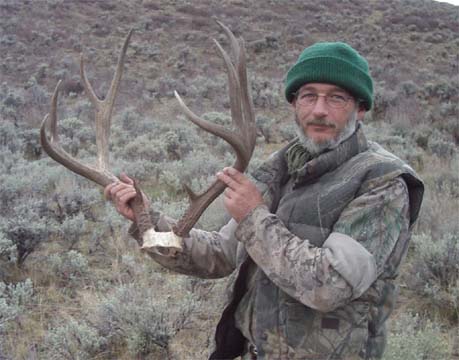
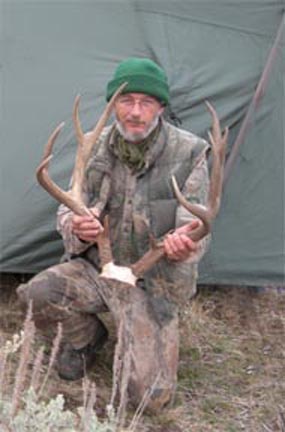
Bill took this buck but has not written its story up!
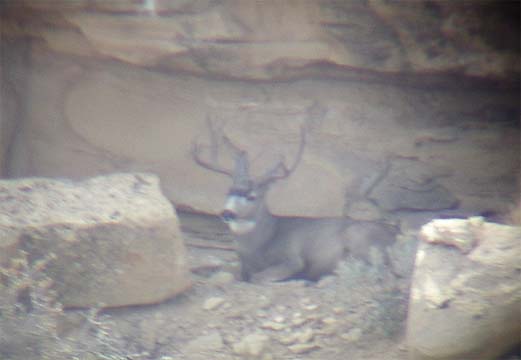
This buck was resting in Box Canyon, but was not big enough for me, this early in the hunt.
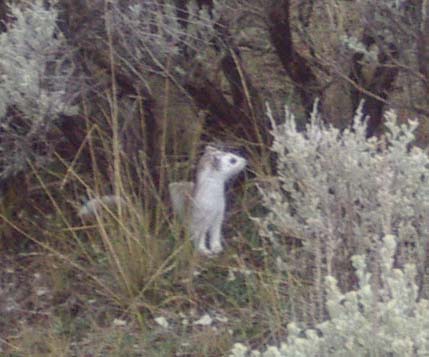
This weasel came around camp two days, helping himself to some of our discarded food.
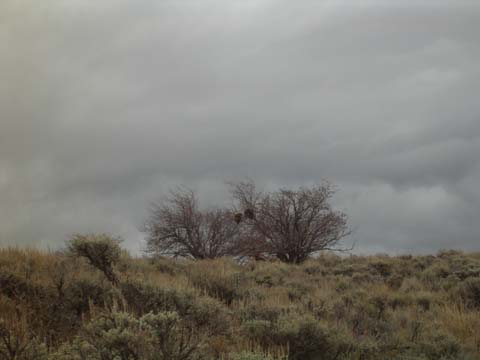
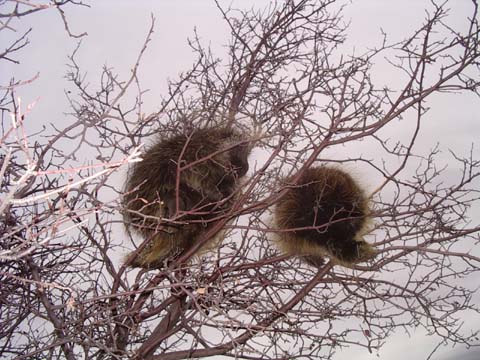
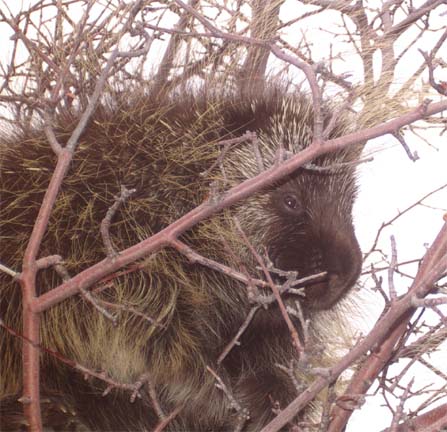
These two porcupines were resting in a serviceberry in one of my hunts.
Day 1 (this narrative starts after we broke camp and Bill went off alone, about Oct 22)
We broke camp in an occasional snowfall Friday and escaped into the teeth of the coming storm. Saturday morning, David left a trail of mud south to Denver and Craig & Sandy limped Craig's beater west toward home. I rolled over in my motel sheets and caught a few extra winks.
As the weather roiled outside, I re-upped for another cozy night of $75 comfort and enjoyed the strange wonders of Cable TV.
Sunday morning dawned clear and cold. Although I'd already decided to eat my Montana antelope tag, avoiding a fourth week away from home, I still had my Wyoming goat to hunt. No bad weather to use as an excuse anymore, it was time to face the wind and do the deed.
I sat in the Bronco until the ice melted from the windshield, then filled my thermos at the truck stop and spent a good half hour, and some fifteen dollars, checking and changing fuses until my turn signals came back. Then off toward Saratoga.
The farther south I drove, the heavier the blanket of snow on the ground. As I skidded down the muddy/snowy county road to visit my ranchers, the vista was one of white snow, red willows, and black cows. And no brown & white antelope. Where I usually see a number of groups, lounging in the security of the private bottomland and adjoining ridges, I saw untracked whiteness.
I drove past my first ranch, Will Hill's, intending to check out a special spot and visit with the other rancher first. Twelve miles of driving and I saw only a trio of antelope, running at 300 yards from my drive-by on the county road. I locked my hubs and 4-wheeled a left 100 yards down a secondary public road that almost borders the special spot and gives a different view of it. Nothing. I looked to my left at an off-limits alfalfa field that usually starts me to drooling, but saw only a pair. I continued on to my special spot. Again nothing. Cows and cow trails, no spoor of wandering antelope. So, after a bit of tricky sliding to turn around, on to the ranch house.
I spoke with Dick Mowry (now in ill health) and his wife. They didn't know where I might find any antelope, and were sure that I couldn't safely drive anywhere in the snow-covered mud (the idea that I might trudge any distance for my hunt seemed alien to them). I gave them a couple of bottles of good California wine, a touch of my home to theirs, and left to see what I could see.
In low spirits, I returned down the county road. Opposite the Hill ranch entrance I made first tracks on the road by his haystacks on the State land. I went all the way to the cross-fence and parked, put my spotter on its window mount, and took a look around. I'd shot prairie dogs in the pasture behind the stacks in 2003, and Ted had once made a half-hearted, and hopeless, stalk on a 'lope there. There were none in sight this time. Then, far off, my binocs picked up the heads of a pair of bucks in a valley beyond. After three long weeks of camping during the deer season, with my car now stuffed willy-nilly with gear, no easy place to set up a new camp, motels costing $75, and prospects for picking out a mature 'lope dim, my trophy standards went out the window- I had horns in sight, time to figure out how to bag a set for myself.
I couldn't tell how far away they were. Up my cross-fence there was the beginning of the low ridge that curved around and down to the county road, bounding the pasture and the valley. I considered driving up the fence and getting behind the screen of the ridge but I'd be fully exposed on the long stalk still remaining, walking down the gentle slope of the snow field. Everything was uninterrupted white, and the land, save for the ridge in the background, was all but flat -- there was little reason to do ought but take the direct approach, and little enough hope of success with that plan.
I dug through my fully packed car and brought out the snow-suit that I'd bought a number of years before for coyote hunting but had never used. It's a size Large, too much for my slight frame, but with ankle ties, a drawstring waist, and adjustable cuffs I was able to make the ends fit and let the middles billow as they would. I wore my waterproof shell underneath as my only warmth and protection, for its lack of bulk, but its tail is several inches longer than the white top, so I had a 'skirt' of brown camo around my hips. Picture me this, Batman - brown boots, white pants, brown tutu, white chest, brown camo daypack, white sleeves, brown gloves, and orange ball cap. I'm glad I had no companion to snap a photo!
I could no longer see the bucks, so they couldn't see me, so I began plodding across the pasture. I came to a winding difference in the snow and figured it to be a cow trail; one step learned me otherwise- it was a drift-filled irrigation ditch! I walked about 600 yards and approached a slight rise in the terrain. I thought the bucks might be just on the other side, so as I ascended I dropped to my knees and took the next 100 yards walking like a double-amputee in an amateur skit. I peeked over the top and discovered A) the antelope were yet far away (my Leica 1200 couldn't even give me a reading), and B) the bucks were not alone. I could see parts of three different herds scattered in the valley -Oh, joy: more eyes to fool!
I continued kneeing my way down the other side of the rise and, when safe, resumed the hominid posture. Soon a trio of antelope came out of a little gully on my left and ran ahead of me, towards my quarry. I thought I was sunk but the fence at the end of the pasture ricocheted them. They milled at the fence, ran along it to the right, came back to middle and milled again. I'd continued walking, so I figure they decided not to take the time to cross the fence; they ran right again and up the hill out of sight.
I clambered over the fence in my loose costume and kept on slogging through the 6 to 10 inches of snow. Now on BLM land, the terrain had changed from mowed pasture to natural range. There was sage but it was very sparse and very low, so low that it only made bumps in the snow and didn't significantly change the pure white aspect of the country. But, of course, it made walking that much more difficult.
A further 200 yards brought me to another rise and again I waddled on my knees. As I approached the top, expecting to be right on the goats, I removed my daypack, hooked my left elbow through one of the shoulder straps, and, holding my rifle off of the ground in my right hand, I inch-wormed forward on two knees and my left hand, dragging the pack forward with each 'stroke'. I stopped when I could see antelope. I saw now that there were at least 60 animals herded up here, in three or four groups, but spread out over several hundred yards. And my range-finder showed that I was still 700 yards from the closest group. I was in a pickle. There were no more low rises to walk behind; it was me, my orange hat and brown skirt, and a snail's pace, against 120 8-power retinas.
I had my scope caps closed, thank goodness. Shimmying along had gotten plenty of snow on my binocs, tucked inside my snow top though they were, and it had even invaded my snapped coat pocket where the range-finder was. My gloves were soaked and icing up, as were my pants legs, left sleeve, and the whole front of my suit top.
Onward and downward, down the rise and into the valley of death crawled the still-hunter. I crawled until I was was exhausted, stopped, ranged them again - and found I'd only gained about 50 yards. And again. And again. ... It was tiring work, slithering along on three supports, holding the rifle dry in the air, through the snow. (I never thought to survey my backtrail- it must have looked some weird.)
I'd received only short looks from a few does, and one buck was bedded facing me, but I figured that my luck couldn't hold out much longer. Most of the nearest group, including the boss buck, had drifted away from me. My goal now was to get to 400 yards of any decent buck, and there was were two fellas offering themselves as candidates. Several times I stopped in my 'swim' where there was a handy sage bump on which to set my daypack as a rifle rest, and pulled out the range-finder, only to find that the distance was still too great. It seemed that I was laboring hard without gaining any ground!
But I finally made it to a good sage at 400 yards distance. My stock cheat-sheet told me that the drop for my 7-08's 140-gr Ballistic Tip, at 2725 fps, should be twenty-one inches. I figured a 'lope chest at sixteen inches and was lucky enough to find that my boy just filled the reticle between the crosshair and the duplex widening. That meant that I could hold the duplex right on the backline and have the bullet fall five inches into the body; since my long-range groups usually droop, I had eleven more inches of body to droop into (I know, the kill zone is less than body width). There was no wind (in Wyoming [Wind-oming] !). I've never shot an animal at 400 before (and hope to keep it a rare occurrence), but the past two years playing with those 10x16 plates out to 550 yards, and the mulling of long-distance shooting and its problems, and study of drop tables, and many 300-yd paper targets, gave me the confidence to take the shot in this last-ditch effort.
The better buck lasered 430 yards and the other 404, so I chose conservatively. He'd been slowly walking towards the rest of his herd, getting farther away, so I settled into it and touched the Model 7 off. He broke into a fast trot but gave no sign of being hit. Then, after about 75 yards, he slowed and showed a limp; and then just folded back on his butt and down. Yeah!
The other antelope ran up the far ridge as I walked to my buck; it was quite a sight to watch all of those tan bodies streaming away over the sea of white. I checked for the trail before I reached the animal, found his and back-tracked it. I saw the initial light blood spray and the dirt left on the snow by his jump-start. There was very little blood along the rest of his trail but what there was always had hair attached, and more hair than blood.
If you're a fan of the behind-the-shoulder lung shot, you'd be proud of this hit: vertically, it was nearly four inches into the white, so just below center, and it barely clipped leg going in and took out a golf ball's worth of meat at the rear of the off shoulder- it couldn't have been any better. (I didn't measure this one's chest but I later checked out a life-size mount at Tom's and got fifteen inches depth. My bullet did droop a touch, perhaps three inches.)
I forgot if I began the stalk at 2:15 or 3:15; it was now nearly 5:30, so I'd taken either two or three hours on that 'walk'. What I'd thought was a pair of bucks turned out to be several herds, and the unknown distance to them proved to be much farther than anticipated, some 2060 yards.
I didn't relish the thought of walking all that way back to the car for my pack, and darkness was not far away. My map showed that I was only 3/4 of a mile from the county road, so I began by simply dragging the old boy that way. I expected the snow to make it easy sledding but soon thought better of the idea. I considered gutting but that would use up much of the daylight remaining and I'd still have a hard drag ahead, so I gave in and did the usual quartering job. I always keep three quarter bags in my daypack, so I was set there. Unfortunately, for this occasion, I don't carry a saw; so I had to cut and twist off the head. I was able to fit two of the bags in the pack, I let out my rifle sling and wore it cross-chest over my shoulder and the pack, picked up the third bag in one frozen-gloved hand and a horn in the other, and set off for the county road, pants legs frozen and chuffing with each step.
It was dark before I reached a fenceline one pasture from the road. I was tired and worn out; that little daypack was not made to carry heavy loads, and my hands were cramping up from gripping their burdens, and I wanted to get to Hill's house before their bedtime. So I dropped everything except my GPS, flashlight, and emergency buttpack at a corner, hung a Cyalume lightstick on the barbed wire, and slogged my way to the road. Two more miles, but now on a hard (frozen) dirt surface, and I was back at the car and a cup of lukewarm coffee.
I drove to Hill's house, knocked, and alarmed them with the lateness of my visit and the appearance of my costume. I had more of a problem entering their house with my ice-encrusted suit and muddy boots than did the Mrs. I met the daughter for the first time, a handsome girl- in contrast to the son. He's something; he wears a hat that Jed Clampett probably threw in the trash, has lanky, stringy hair, is a bit gap-toothed, and speaks with a very rural drawl. I've little clue as to what he's got behind the facade, but that facade really takes me back to old Virginny.
Ted and I had visited with them a couple of weeks earlier, so my presence was not a total surprise. I told them that I was there to drop off some wine, and also hoping that their son would take me out on an ATV to recover my pack. Oops, they must be the only ranchers left who don't own an ATV! But, after a cup of hot (instant!) coffee and comparisons of their map and my description of where I'd left my gear, son (Gary, I think) went outside to warm up the truck. I said my good-byes and thank-yous to the family, and then we two drove our vehicles to the county road. There I parked and climbed in with Gary. He began on the two-track (sno-track?) I'd spotted the antelope from but soon turned off onto a branch that only memory could see under the drifted snow. We wound along the fences and arrived right at the correct corner. I recovered my stuff and we drove back. He was intrigued by the lightstick and the uses I told him I put them to, and mildly curious about my rifle and its chambering. I offered a haunch of 'lope but he declined; they don't hunt, Mr. ate enough venison in his early years to last him two lifetimes. Gary was most interested in California, its topography and agriculture. He dropped me off at my Bronco at 9:30, and I insisted he take $40 for his help. It's likely that I would have moteled and returned in the morning, being pretty beat; he saved me quite a bit of time and effort.
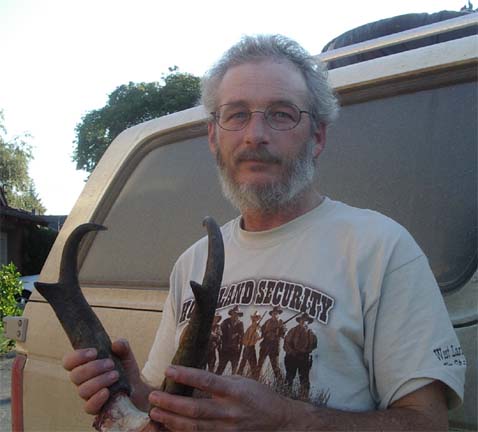
Back to Rawlins and the motel, where the next day I butchered and packaged. The horns are small, only 12", scoring 65, and with the tiniest of prongs- the longest measures 3 inches, and that's from the back of the horn. But this will remain one of my most memorable hunts.