We Be Elk Hunters
(but not elk shooters)
David's Story 2006:
The Sunrise Silhouette
First posted October 31, 2006
Last updated November 5, 2006
Day Four

Wednesday Oct 11
5 am Craig shakes the tent and yells at us to get up. Pitch black and freezing. Ground is frozen solid.
Tucked in my sleeping bag, I start by putting on my cap with the flashlight clipped to the brim. This is new this year. Craig had showed me something similar last year, with a very small flashlight, probably a AAA with a regular bulb. I bought a Gerber single AA LED flashlight that easily clips to my hat. It is very handy around camp in the dark, as everywhere you look there is light. (Compare that to this picture from last year: Bill with his flashlight in his mouth.) Just like a single-hand-opening knife, the hat light is very handy. A second thing about them is that since they use a single AA battery and they have an LED light, you will never have to buy another battery in your life! Why, you ask? Because you can use all the AA batteries that you retire from your GPS or walkie talkie because they are low. These still work great in an LED flashlight. After I found out how useful they were at the last weekend at the Ranch, I got one for each of the hunters in Camp, gave them out last night. (Ted, I have yours in my Ranch gear, will give it to you next season.)
The hat light in place, I sit up in my undershirt and wool shirt, wool socks, and wool hat. I dress by keeping my legs in the sleeping bag and putting on my down vest, scarf, and wool hat, then tuck back into the bag for a minute to let my upper body benefit from the warmth in the bag. Then I get out of the bag, swing my legs out, take off the heavy bed socks and put on my wool pants, hiking wool socks, then my boots. My camo shell is on the cot coat hanger at the foot of the bed. Don it and head out into the weather for some Northern Exposure: new term this year, originated in part by Sandy, referring to exposing some of your warm, private parts to the wind and snow. Northern Exposure is easier for guys than girls. Sandy just says that guys have better plumbing for camping. We tie when it comes to Southern Exposure. I managed to avoid Mid-night Northern Exposure the whole trip, waiting (just barely) for morning. After Northern Exposure, I head to the Cook Tent.
Sandy and Craig are always up and dressed before Bill and I, and they are in the tent, Sandy worshipping the God of the Propane Heater (for good reason). Craig, being the good soul that he is, has Bill’s coffee (prepped the night before by Bill) on the stove. This is a new propane stove, very efficient. So efficient that the Cook Tent is almost hot and Bill burned his fingers during the first week when he tried to pour some coffee out of the pot. I don’t drink any coffee in the morning, for fear of starting peristalsis and having to get some Southern Exposure in the cold black of dawn. I prefer to wait until the warmth of the afternoon, if I can. A poptart and I am ready. I put together a salami sandwich with hot mustard, some candy and water, and stuff it in my pack. Bill is going to stay in camp, cutting up his meat.
Weather looks good, some fog and moisture hanging in the air but the wind has yet to pick up. Dry overnight, so the roads are slowly drying out. I plan to use the opportunity to head to the north rim of Waterfall Canyon, to the area I have gotten my ‘04 and ‘05 bucks. I intend to start farther west and survey the Bowl then work my way east to where I shot from in 04. Craig suggests driving out via a new route that will avoid the balky lock at the road as well as the second gate. Head out of Camp to the gate, but take a 90 degree left instead of the normal 90 degree right to the gate. Drive for a bit then look for a diagonal road to the fence road, and then proceed as normally. “Lots easier, faster. You can’t miss it.” Fateful words. The Explorers’ Club has a saying: “If you have an adventure, your planning was bad.”
I get in my SUV and head out. The dark and the fog make visibility limited and navigating problematic. You need to understand what “road” in Wyoming means. It means that sometime in the last century somebody once drove there. The “well marked road, you can’t miss it” means that in the light of day you have a chance of seeing it if you look at the right angle and, with the perspective of a quarter mile, you might see a pattern of two tracks going through the sage. “Look for it, you should be able to find it without any problem” means that James Fennimore Cooper’s Deerslayer could not find it even if his mother’s life depended on it.
The road is well-traveled that I am on, but I am looking for the turnoff. No description of where it is, 100 yards down the road or two miles. No roads on the map, no idea if it has been traveled recently or not. I cross a greensward, and something makes me think the turnoff might be here. I peer through the gloom, seeing just sage and greensward, nothing that resembles a road. The trouble with greeenswards is that they hide road well: there is no parting of the sage to suggest a road, just rock and grass. It is a road, or just an extension of the greensward? I turn the jeep around, try using the headlights. Nothing. I drive on, no turnoff, and then another greensward. “Lots easier, faster” runs through my head, as the sky starts to turn a bit lighter, but still dark because of the fog. I think I see a road, and turn down this greensward. Road or just a clearing? There are no tracks. I drive a bit further and see some ruts. A road. I drive further and the “road” starts to have such ruts that I am high centering. I am feeling really charitable to Craig right about now. The sage is scraping the sides of the rental car, and I am thinking of the cost of repainting the SUV. Although I can hear the highcentering scraping the differential, I am not getting stuck, so I keep on. The road (or excuse for it) improves, and I drive on. I can’t tell if I am going in the right direction, but it seems right. Is this just a dead end? The real road? Next time, no “faster and easier” for me. The fog and dark continue to make driving a challenge, but at least this “road” continues. Finally, I see a fence on the far side of a road ahead and know that I am in the right place. Time is wasting, I want to get out before it is too light.
I turn left and drive to the point where a stream crosses in a greensward. Last year, I felt that this area was too swampy for me to risk driving across and get stuck. My vehicle has smooth, city tires, nothing like the knobby stuff on Bill’s and Craig’s and no where near the power or ground clearance. I look at it and decide again not to risk it. It adds another ¼ mile and another hill, to my several hills and 1 ½ mile hike, but getting stuck, with no shovel, no boards or rocks around, etc, is no fun. I park, get my gear on, and head out. The ground is frozen solid. During the previous day, it was so mushy that the cows had churned it into a mini Mud Himalaya, now frozen in place. It is hard to walk on the road, but even harder to try to walk through the sage on these hills. I walk on, with the fence that marks the southern limit of our hunting area on my right. Up one hill, down. Up another steeper hill, down. I see deer now off in the sage. It is so dark I can’t tell much other than they do not seem large enough to be of interest. I keep walking, turn the corner of the property and head south. I keep to the road for about a ¼ or ½ mile, then angle out into the sage. I know where Waterfall Canyon is, see its rim in the dim light. The fog seems to have lifted, I can see stars and mountains in the distance. To the east, the sky is lighter but still not yet red. Here some deer are out on the flats in the sage to my left, does.
I come up to Waterfall Canyon approximately across from the Stone House, with the Bowl to my right. It is light enough for me to see across the draw fairly well, enough to see that there are no deer. Nothing to the right in the Bowl. I creep forward, edging around a serviceberry, and peer into the draw. Nothing. I continue forward until I can see the bottom. Nothing. I scan to the right and left in Waterfall. After I am sure I have seen everything, I move back from the edge by about 25 yards and move east along the rim. I creep forward again, using the sage or serviceberries as I can, scan, move forward. I cannot see anything on the flats beyond, note how close the Stone House seems. The Canyon is rather narrow here at its beginning. The light is increasing, but there is barely any color in the close objects, none in the far objects.
I move back then left. I scan the sage on my side, nothing. The sun must be close below the horizon, as the clouds are beginning to turn pink. I move east to another section of the Canyon, creep forward, peer in. Nada. I move back, move east. I scan the flat on my side, I can see farther and farther as the light increases. The sky now has a wonderful red glow, but the sun is still below the horizon. There are some deer in the sage back from the Canyon, don’t seem to see me. I start to move back to the rim when with my naked eye I can see deer on the horizon, 500+ yards away, and they seem to be bucks. I bring up my binocs and about drop my shorts: BIG bucks! I can easily see their antlers at this distance and they look big. I kneel down, to better blend in with the sage, which is only shin high. I stare hard: the horns are good. There are two bucks, and the one on the right is definitely the big one. The rear forks are quite high. I struggle to drop my pack. It catches on my vest shoulder straps and won’t go to the ground. I fight it a bit. Now is not the right time for this to be happening. I finally get it off, whip it around, and get out my spotting scope. The big guy has very high rear forks, amazingly high, black silhouetted against the red of the sky. The front forks are weak, about 4 or 5 inches. I study his buddy, the small guy, then turn back to the Big Guy.
He is not as good overall as some of my previous bucks, but this view of him is classic, like a cover of Outdoor Life or Field & Stream. Pure black on red. Photographic. I continue to think if I want him. The stalk will be a challenge, as the sage between us is ankle to shin deep. I get out my rangefinder and he is about 530 yards. He moves a bit then lays down in the sage, still silhouetted on the ridge. The Little Guy continues to feed. I could drop down into Waterfall Canyon and move up on them without being seen, but I would not be able to keep them in sight. The ridge that they are on extends from the Waterfall Promontory in the south all the way to the skyline to the north. I had never noticed this ridge or its extent before. The Big Guy continues to sit in his bed, perfectly silhouetted against the red sky, and the Little Guy feeds nearby. The rear forks are really tall. Should I take this one, even though he is weak in front and a bit thin? I debate with myself for a bit, look back at him though the spotting scope. This black silhouette against the red sky, with his horns showing up at this distance to the naked eye, is just too classic. I make up my mind: this bud’s for me. I am going to go for it. The Big Guy.
I plan my stalk: drop over the rim, just barely into the ravine, and work my way forward. I will need to “prairie dog” up every once in a while to make sure they are still on the ridge. I can’t believe how long they have stayed on the skyline. The day is dawning and I expect them to move. They are in high sage, it was pure luck they were standing when I first looked their way. I would not be able to see them in the dark if they were both bedded, but I felt that they would move out soon.
I realize that it would be silly to move along the north rim of Waterfall and not hunt, and what the heck, I might see something bigger. However, I would have to sacrifice some concealment towards the Canyon to maximize concealment toward the Big Guy. I walk slowly toward the Canyon and then work along the rim, about 10 feet below the rim. I glass the far side of Waterfall, where there is an aspen grove and scattered serviceberry. No deer. I “prairie dog” up, move back up to the top, just enough so that my head is still below the level of the taller sagebrush clumps and I can just see the Little Guy and the Big Guy. No change: Little Guy is browsing and Big Guy is bedded, with his antlers profiled from the side. I am not sure that I ever saw him from the front or back while he was on the skyline. Move back down and along the rim. It is light enough now that I can clearly see the far side in color. Prairie dog up, no change. If they feed away from me, I plan to quickly move across the plateau to the ridge, then slowly peek over the top. If they move north, straight away from the Waterfall Canyon, it will be tough, as there would be no concealment available. If they move south, into the Canyon, I could move across the plateau towards them (there is a part of the flats that extends out onto a small promontory out over the Canyon) as soon as they were below the rim and could not see me. I think I understand all possibilities and have them covered. I move back down and along, getting closer all the time. The 500+ years are down to 475 or so.
I am excited but under control. Scan for deer on Buck Ridge: very hard, as I am looking directly into the rising sun and the reflections on the dirt and grease on the binocs and my glasses makes it very hard to see. Buck Ridge is very hard to hunt at sunrise from the north rim. The far side has nothing, not even on the far plateau.
“Prairie dog” up again, and things are changing. Big Guy is now up and feeding. It is hard to see them as they are still quite dark compared to the sky above them, but it looks like they are feeding toward me. Wait, they aren’t feeding, but simply walking, fairly quickly, toward me. I check to make sure I am not profiled to them. No, I am still quite low in the sage and my head is not taller than the tallest sage on the rim between us. My body is still down in the Canyon, below the rim. They are definitely moving towards me, which is fine with me, it closes the distance. They come off the Promontory Ridge and turn toward the Canyon. They are now entering the draw that I shot across when I got my ’04 buck, the one that Ted and I hiked out when he helped me pack it out (Ted, thanks again. It was very nice of you to give up some of your hunting to pack out the meat. Haven’t forgotten. Now that you got your Pistol Buck in Waterfall, we have bucks in common.)
I watch them move and make my plan. As soon as they start down the incline into the Canyon, their attention will shift from watching the plateau and will focus only ahead of them, down the slope of the Canyon and beyond. As soon as this happens, I should be able to move quickly in the open on the plateau, cross the flats to the rim nearest them, and get into a shooting position. I get ready for the sprint. They walk quite quickly to the head of the draw and head down. I am surprised, but they amble or sprint down the hillside. They do not seem frightened, and I know that they cannot have seen me, but seem to be having some fun or are really interested in getting to where they are headed. I start out walking as fast as I can. I don’t want to get out of breath, and I know where they are headed. I have spent two full days studying this hillside, in ’04 and ’05, so I already know what the cover is, etc. I should easily be able to see them. Even once they hit the bottom, I should be able to see them for 100 yards or maybe even 200 yards.
I cross the distance to the rim near them, about 100 or 150 yards. There are some serviceberry. I choose the right hand margin, as that should give me the best view in the direction that they are heading. I see some sage of about two feet in height, perfect to set up behind for a shot. I approach the sage, binocs up, and scan the slope the bucks descended. They have gone below this level. I keep moving forward, getting a view of more and more of the ravine, but moving slowly now. I will be skylined to the bucks, and if they look this way, I need to be a stone. I keep advancing until I can see all the way to the bottom. They are nowhere to be seen. I can see the entire hillside: no deer. They have evaporated.
I scan all of the possible hiding places: all the serviceberry, nothing. The sage is really short in this part of the Canyon, but I scan the sage: nothing. I am sure that they cannot have moved beyond my sight in the few minutes it took me to get to the rim, they have to be here somewhere. There are some serviceberry on my side of the Canyon but closer to me than the ravine. They might have moved directly toward me, so I scan that as well and try to hold still in case they are very much closer to me than I suspect. I try to hold still and yet get a good look at all of the territory. They have to be here, but nothing. I keep scanning for about ten minutes, searching, searching. They have to be here. Nothing.
Where could they have gone? They would almost certainly not turn around and go back up. They might be hidden directly in front of me, but it would be very unlikely that they would immediately bed down. I cannot imagine that they have moved out beyond my area that I can see. Where are they? Deer do not evaporate or sublimate. The light is now quite good, that is not the reason. I keep still and still keep looking.
The creek takes a weird bend at the bottom of the ravine that they came down. It is right below me. A small crest, the end of a ridge, comes from the far side and forces the creek to bend very far to my side, then where the ravine bottoms out, takes a 180 degree turn to the far side, then flows fairly straight away from me, to a beaver pond.
I am scanning this small crest when I see some horns on the far side, then a buck comes up over the top. The crest is so small, I barely noticed it before. It cannot be more than about 20 feet tall here, but it is enough to hide this buck. He comes to the top and stares, directly at me. I am still skylined, as I did not move over the rim and down into the Canyon, for fear of scaring them off, not knowing where they were. I hold perfectly still. There is a sage in front of me, so only my head and part of my shoulders should be visible above the sage. There is a group of serviceberry to my left, not hiding me, but at least I am not out in the far open. I breathe, but nothing more. I do not lower the binocs or turn my head. Frozen. After an eternity, his gaze seems to be directed slightly off to the side. Then he looks in another direction and I know I am safe. He scans the territory that he has just come into, then starts feeding in the sage on the crest. Come on, Little Guy, bring the Big Guy up there with you! I watch him feed, can see when he nibbles the tops of the sage or feeds on forbs at the base of the sage. He feeds to the right, then to the left.
I finally get the realization that if the Big Guy shows up, I am not ready to shoot and won’t be able to move much. So I drop the pack off my back, get out the shooting sticks, set them up, all behind the cover of the sage in front of me. I set the gun up on the sticks, so the bipod is now a tripod: two legs are shooting stick and one is the gun.
I watch him feed. Come on, Little Guy: bring the Big Guy up! The sky is full light, the fog has disappeared, scattered clouds. I scan all around, so that the Big Guy cannot sneak away from me. Nada. Come on, Little Guy! Bring him up! Instead, the Little Guy feeds over the crest away from me and disappears. I am alone again, two four pointers hidden, at least one on the far side of a miserable, little ridge! I keep scanning, because I don’t know where he (and possibly “they”) will go. But I am ready.
In a few minutes, while scanning the hillside, I spot them. Big Guy and Little Guy, with Little Guy in the lead. They are walking quite quickly along the cow path along the creek, directly away from me, about 50 yards beyond the ridge. How they got that far beyond the ridge without been seen is a mystery. Probably I was looking at another area when they first appeared, and they were moving so quickly that they covered that distance in just the time it took to scan another area and look back.
The rifle is in position, so I just raise it to my shoulder, slip off the safety, and aim. The alignment is not perfect. They are heading almost directly away from me, but I am quite a bit above them. It is not exactly a Texas heart shot, I can see along his back, but a bad angle. Not much time, as they are getting farther and farther away, and dang it! they are moving quite fast. I steady the crosshairs and apply pressure to the trigger.
Click! That’s right, “click”, not “boom”. I work the bolt, the bad shell ejects, and I put another one in. I am just a bit unnerved but lay the crosshairs in his chest (the bad angle means I cannot place it where I might want, in the lower 1/3 and just behind the front shoulder). They keep moving out, at a walk, not a bouncing run, and I squeeze.
Now I get a “boom” but the deer merely put it in high gear and keep moving. A miss? I work the bolt and squeeze, a bit faster this time.
Boom. Big Guy just stops in his tracks. Weird. He does not fall, but he doesn’t even move, not another step. Weird. He just stands there as I put another shell in the chamber. My guess is that the crosshair pulled to the left just as the gun went off, and I think, putting these ideas together, means I have shot him in the gut. He is not moving, so I am not shooting (still a very bad angle, straight away), but ready on the instant. Several minutes pass. I never saw Little Guy, he must have moved out. I concentrate on Big Guy, with the crosshairs on his front half, ready. A few more minutes go by, then he lays down. His head is still up and his gaze seems vigilant. Down, not out.
I survey the lay of the land. I can come up on him from behind the little crest that Little Guy had been feeding on and cut the distance in half as well as move to the right and get a better angle on him. I note landmarks to guide me when I am down there, with a different perspective on the area. I grab all my things, sling the pack on my back, keep the shooting sticks in my hand, and back off the rim. I head quickly back where I came from then dive off the rim, careful not to fall but not trying to be absolutely quiet. I need to get to the crest. I get to the bottom in 30 seconds, cross the creek, note my landmarks, move to the right and then go up the back side of the crest. I have chosen to climb it where it is closer to 60 feet high, to get closer to where he lies and to get a better angle. I cannot go much further right without moving farther away from him. I get to the top of the rise and slow down. I binoc the area, but still cannot see to the bottom of the Canyon. I move quickly up more and glass. After a few iterations of this, I see him, same posture: head up buy lying down, a slightly better angle but still mostly aligned away from me. I set up the shooting sticks, place the crosshairs on him, and evaluate the situation.
My angle is still rather bad. I would have to shoot through the guts to get to the chest. I am about 125 yards away now, close enough for shooting, but I doubted I could finesse a neck shot. I decide that if he wants to sit there and bleed to death, I won’t object. If he runs, I can shoot. He doesn’t move for a few minutes. Then he does move, but he doesn’t run. He just stands. After a moment, he looks right, then looks left. Then just stands. The angle is bad, he is not moving, I hold my sights on him and wait.
After a few moments, he takes a step, but luckily to his right, which brings him closer to broadside. I shoot and he takes off running. I chamber a round. He has crossed the creek, moved up about 20 feet onto a level place alongside the creek. I shoot, with a great angle this time: true broadside, and he goes down like a ton of lead (which, given the number of shots I took, may not be far off!)
I put in a fresh round, but he is down. I am pretty sure I see one point sticking up from the sage. It might be a branch of sage, but probably not. I wait only few seconds, then plan my approach. I can’t see him, so I note one large bunch of sage and some lighter color grass beyond him, on the far side of the creek. I head directly down the ridge toward him. As I lose altitude, I lose sight of the horn, but my landmarks are good and I move directly to him, gun at the ready. No need: he is down for good.
I poke him once with the barrel, but he is dead. I drop my pack off to the side, pull the shell out of the gun, and examine him.
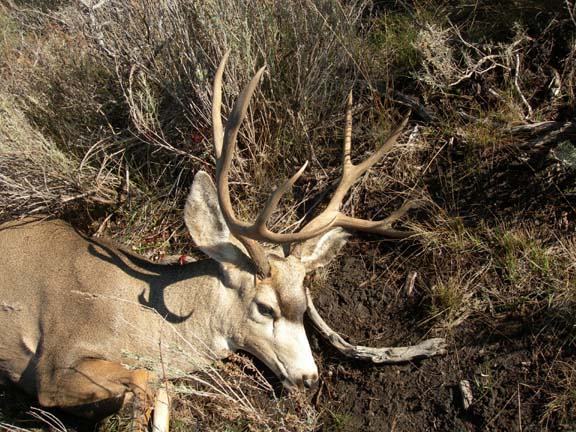
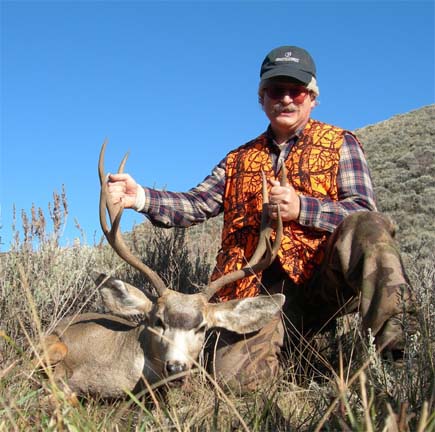
There is one shot on the right chest, right were it should be for a double lung shot. This must have been my last one; should have been my first one and then there would not have been a second one. There was one shot in the chest region but just above the spine, too high to hit the bone or nerve. There is one shot that went in the right rear leg, in the ham and above the knee, but medial to the bone, missing it. The shot then went into the belly, opening up the body wall, with intestines protruding. There is also one exit wound on the left side, just about halfway up from belly to spine and about at the junction of the abdomen and the chest cavities. Here is my guess: First shot: high, a miss. Second shot: ham, guts; but I am not sure of the exit. This stopped him in his tracks. The third shot was high, and the fourth shot was the chest. Did the job, but not proud.
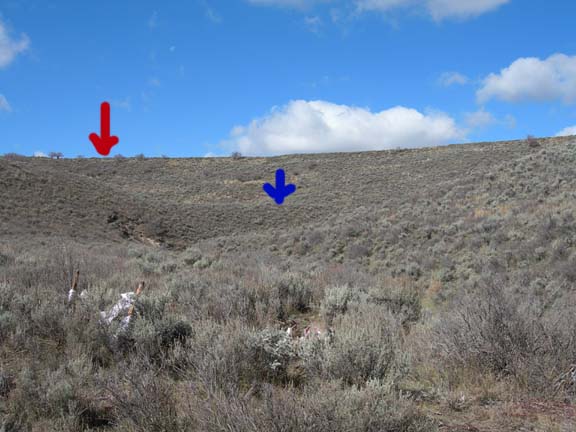
I was at the rim, at the red arrow, when I took my first shot. The blue arrow marks the crest where I saw the Little Guy. I was on that crest, below the red arrow, for the third and fourth shots. The deer is in the foreground, left.
I examine the shell that went "click". The firing pin just barely dented the primer. It was not a shell problem (read "not a Bill problem", since he loaded these up for me) but a firing pin problem. This has happened twice within the last year or so.
Got out the camera, some auto shots, then got ready for quartering. Bill and Craig have been giving me no end of guff about how slow I am, so I time it. I laid out the deer bags on the sage, partly inside out, to be ready when the quarter drops in. Hands all full of blood is not the time to be fiddling around the pack to find the bags.
I skin and quarter him, takes about 1 hr 30 min. (although I can't find the time in my tally book, rats!). I load up the pack with one forequarter and a backstrap, and start out. I plan to follow the cowpath he was on, going upstream and pick a side canyon to take to go up to the plateau, then up a greensward to the road, take it to the corner and then to the car. The load is heavy and the gun plus pack heavy and awkward, but this is hunting and the norm. I take a few rests but make good progress, find a great path up from the Canyon. The frozen Mud Himalayas are all now just Mud. Tiring footing. I get to the car, pretty tuckered out, not sure I can get back to the deer and out again. I try to radio Bill, but cannot raise him. Would not mind some help, if he was available. I rest and eat and take a nap, about 3-4. Get the frame pack, feeling a bit better, and head out. I leave most of my gear, just some water and candy, plus my shell in case it gets cold as afternoon becomes the evening and the sun sets.
I find the deer without any problem, load up, and go. The pack is quite heavy, but I find that my legs work well, the strain is not too much. The main problem is pain under the waistbelt, esp in the rear, but I move a bit of the load to my shoulders, it is tolerable. I can keep going a fair distance, but stop to rest twice before I get to the path out. At this point, I hear Bill on the radio. He is out looking for me, and I guide him towards me. In about three minutes, I see him and he joins me at the bottom, offering a beer. He kindly agrees to take two of the three deerbags and we take the trail to the top. He has been able to drive his Bronco closer than I could drive my slick-wheeled city SUV, so our hike out is delightfully, delectably shorter. We head to camp.