2007 Wyoming Report: Bill’s Story

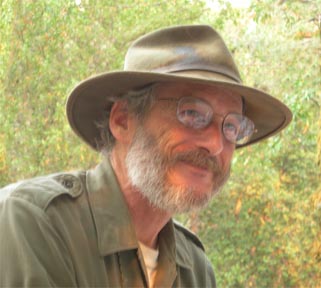
It's not easy to type error-free with Band-Aids ® over a few fingertips. During my first butchering job I sliced into my left thumb tip - band-aid one. Barely into a later animal, and ruining my plans for a long afternoon of slicing & dicing, I almost took off the tip of my left middle finger. It hurt and spewed a lot of my blood on the meat. I then got back into the job too soon and finally noticed that there was too much blood around - it was mine! - band-aid two. And throughout, I had an injury on the tip of my right thumb. It became a weather crack and, even though I dabbed it regularly with the tiny tube of moisturizer that David passed out, as soon as one part of the crack sealed up, another would open. I wish I'd kept a band-aid on, but didn't. It hurt and worsened. It's healing up now that I keep Neosporin ® and a band-aid on. - band-aid three! Actually, while out there it was a band-aid underneath plenty of wrappings of tape, making a pretty clumsy bandage that would protect me and itself, and survive several days of hunting, cooking, pooping, butchering, etc., before getting changed. Yeah.
'Twas an enjoyable but uneventful trip; I have stories but no capital-A adventures to relate.
Five shots, five big game animals; seven shots, one coyote. I need to keep in mind how skinny the doggies are and how high are my big game trajectories.
One deer doe, taken mere yards from Ted's spot-of-success, was a simple opportunity. It was the second-to-last evening of the deer and antelope seasons, minutes left before dark. I rounded the tip of the bluff, side-hilling, and spooked out a pair in the rocks in front of me. Eager to fill my tag, I sat and plunked it at about 50 yards. I went up to it, discovered it was just a fawn (OK by me - less to carry, tender), dropped a lightstick on top and noted location in my GPS, and continued around the corner to see if I could find a good buck in the last moments available.
Failing at that, I returned to the little guy and three-quartered him out (one shoulder lost to a .30-cal. Partition at 50 yards) as the rain began. I fit him into a single quarter bag (a fawn, remember) and hand-carried him up to the top of the bluff, to the end of a road, in the dark. My Bronco was 1.5 GPS miles away, as the raven flies; it was dark and rainy, I was at the end of a road I'd recently mapped - I laid down my gun, put my daypack with binocs and spotting scope, among other things, on top, followed by the meat bag, and topped with a cherry of a lightstick, and began trodding the road.
As my hike progressed, so did the slickness of the tracks in the road. I went the balance of the distance walking in the (fortunately mostly un-saged) center. Wet and cold, I started up the Bronco and drove out to my road's cut-off. It's somewhere around here. I know it is. C'mon, where's the turn-off?
The spot there, which we call Craig's Log (don't ask), is a long, narrow, grassy ridgetop, and barely reveals the tracks of the main way, much less those of old and seldom-used trails. I ran circles on Craig's Log and used my GPS to know that I was now past and now not yet there, but in the rain and dark I couldn't pin down any tire tracks leading off the hill. Fearful of rutting the roads and sliding down a mountain, I turned around and slopped my way to camp - leaving $3000 of gear (fine optics and rifle) and a bag-o'meat on the soggy ground at the edge of Bird Gulch.
The last day dawned, snow on the ground. I was without binoculars or spotting scope or buck deer. I did have my 7-08 back-up rifle, though. Not daring to scar up Charlie's land 4-wheeling to a primo area, I drove the short distance to a sleeper of a spot, 5-Buttes Draw. I'd walked only a very short distance before I fully understood that seeking a trophy buck in the Wyoming sage is a fool's errand for a man without binocs. The 2.5-7 power scope, so light and handy on my light and handy Model 7 rifle, is little substitute. Clumsy and dangerous to use as a scanner, it doesn't have the power to pick out tines.
So out went my determination to take any last-day buck that I wouldn't be embarassed about - nearly anything would do. I snuck around the line of four buttes (number One is somewhat separate, and is the wind break of our camp), higher than usual. There were plenty of does in the serviceberry patches that march down into the draw, but none of the bucks I'd seen here on a previous walk. Then I looked up the slope of No. 4 to my right and saw a group of three. One was a little fork, another a three, and the other seemed the largest; but through my 7x scope at 150 yards I couldn't tell if it was better than a 3-ptr. Didn't matter - I had no intention of making a long and arduous hunt in the hopeless position my optics put me in. I went prone from the sit I'd been in watching the does (and their frolicking fawns), I think my upright supporting arm was my only rest, and fired when the largest deer turned less toward me. Bang-flop.
Then began an hour's wait, not wanting to educate the others. The remaining pair of bucks did the usual staring & sniffing & wondering (I expect, & vocalizations, also) but eventually went on eating. I often have survivors do the first half of that but then leave as if cursed. Then several does came around the hill, fed through. For the most part they didn't appear to notice the flopped-out buck, although one fawn saw and sniffed it, much closer than any other deer, and seemed to bounce back to momma with a questioning demeanor. She looked where indicated, but only briefly.
I began to get a little cramped and cold, lying there in the snow, so slowly shifted around and in a bit stood and strolled back the way I'd come, garnering only vague attention. I drove around the back side of the buttes, cut between #s 4 and 5, parked, and went up for a look. I was pleasantly surprised to find a genuine 4x4 on the ground, and larger than expected. And so was his body. I returned to the Bronco for my pack. Trust me, even 3-year old buck deer are bigger animals than any doe or antelope! And the fat! None of my other kills had a whiff of it; he carried a full inch over his hams (a bummer to a picky butcher such as I).
I did the dirty work, including skinning the skull plate right there, bopped him the hundred downhill yards to the Bronco, and drove off to rescue the gear I'd abandoned the night before, now that the wind had sufficiently dried the strange soil we hunt in. I checked out the optics - OK; my daypack was only damp in most parts; the rifle seemed fine. I dropped off of the end of the bluff to see if a coyote might be in the area because of the carcass below, but found no takers for my enticing calling.
I drove back to camp via some roads in the antelopier area, hoping to fill my last remaining doe tag, without success, and called it a hunt.
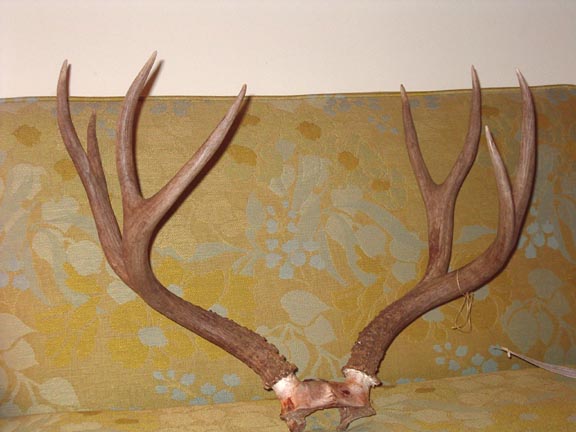
He's not the buck that's haunted my minutes between wakefulness and sleep each night for the past year. I'd passed up scores of bucks his size, and many others larger, searching for Old Mossy Horns. I call this one my One-Penny Buck: one for a penny, a dime a dozen. But he ain't ugly; he's a pretty last-day buck. But scores out smaller than my blacktail!
Random Afterthoughts on 2007
The Band-Aids ® came off at the end of last week. Even healthy skin does not fare well continuously wrapped up.
We had all sorts of weather, again. Snow a few times, though it usually melted off the next day small hail, rain, clouds, fog, and quite a few sunny, balmy days. Temps averaged higher than memory recalls of previous trips, and it was rarely really cold. Wind, naturally. One day the NOAA broadcast predicted winds averaging 30-50 mph with gusts up to 60. I watched snow falling truly sideways.
In fact, it snowed the night before Season Eve. So I slid my way to the ranch on September 30. And passed Craig on the road, off on a jaunt with Charlie and son Chuck. And heard that our camp was not set up. And that I had to sleep that night in an old mobile home at Charlie's ranch HQ. And that we'd lose half of Opening Day setting up our tents.
Craig and I, at least, saw a bundle of coyotes this year. Unfortunately, they kept popping up at inopportune times. I saw one on the cliffs of Box Canyon on two different occasions, but shot only at coyotes that I called, because we were hard at deer hunting. While stationed with David during an elk watch, had a pair hunting for a couple of hours on the bare snow in Hornbeck pasture. On the hillside of 5-Buttes Draw, while I was watching ten bucks and a group of does that joined them, a coyote came down their ridge, stopping only about 30 yards away from the deer. The bedded bucks boredly ignored him, the does were very watchful (but non-aggressive, unlike their reaction to my imitations of a fawn in distress).
I called one morning in Cow Creek. Saw a dog come out on the opposite hillside at 300-400 yards; he just sat down and looked my way. But soon another coyote came from the other direction on that hillside, on the run with a pair of does hard on its heels. They zig-zagged down the hill and I got a shot when he paused at 200+. I missed, as usual, and he took off across the hill like a rocket, with the deer still on his trail. I might have gotten off another round before they passed out of sight.
(Memo to self: Take into account the rifle's big game trajectory when shooting at small animals like coyotes.)
One evening I set aside my meat packing and took a stroll into the gully heads south of camp. At my first set-up my squalling brought in ten does on the double. I had to fidget to get them to move off. At my third, I was just ready to give it up when a 'yote slammed on his brakes twenty feet away, seeing me at that same instant. I couldn't see directly below because of the roll of the hillside. I managed to miss him twice as he tore up the other bank of the draw.
(Memo to self: Choose set-ups with complete views, even, or especially, the very near foreground.)
On the morning of Oct. 6, I hunted along a lower part of the east side of New Ridge. I saw little, save a few hundred sheep, and gave it up early. I still had an hour or a bit more before I was to meet Craig for a trip into town, so, finding myself at a likely looking spot just off the road, on the west side, I snuggled into some sagebrush and called; doe or coyote, I'd take either. In moments a pair of does burst over the top and stopped about 40 yards away, staring intently. I lined up and put a 165gr Partition low in her neck, in a full frontal shot. DRT (dead right there).
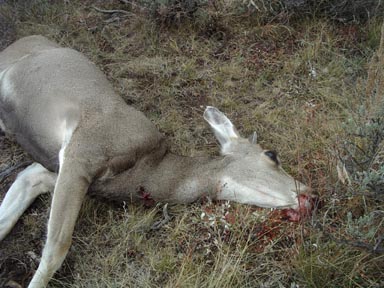
I brought up my binocs, saw a coyote on the opposite rim, some 600 yards away, watching. The morning was chilly and threatening rain, so it soon curled up in a little cove behind some sage. I walked back up-ridge to the Bronco, parked and grabbed a full-length bag, and was only ten minutes late to camp. (Craig was an hour late and then decided to skip the trip. I went in alone. And it rained like a sunufabich, so I slid back to the ranch a second time.)
On the late afternoon of Oct. 22, after I escorted David through some of the after-snow slop to see him safely away to Denver, I stopped at 5-Buttes Draw to try my luck again. This time a coyote came in favorably- close but not too close, and at less than a slow trot. I finally connected on the trip's only dog, the 140gr Partition from my 7-08 dropping him in his tracks, again a full-frontal shot (he kinda grew a second anus). Nice full fur.
While I'm on the subject, one afternoon I discovered a meat bag ripped open and a hindquarter gone. Dang coyotes! And right in camp! A day or two later David reported that he'd found my meat bag outside of the vestibule, with a shoulder loose on the ground. I checked, found my antelope's other hindquarter missing! Dang coyotes! All but in the tent! That made me have to better protect my parcels of protein, nighting them in the Bronco, carting them around with me on drives to hunts (whenever temps allowed), and caused me to give up some hunting time butchering.
So, one afternoon I stayed in camp. I was outside the tent, working over meat on the roll-up camp table, packages of meat on a nearby chair and two legs worth of cleaned bones on the ground. Into the area comes a big white dog, one of Charlie's sheepdogs. From twenty yards he sidled in, very slowly and, in his mind, inconspicuously, eyeing first me and then the bones. He knew exactly what he wanted, and intended to sneak it away. He arced slowly in, retreating a tad whenever I made an odd move. After about twenty minutes he was one dog-length away from the bones, stuttering in. Now sure of him, I "No-ed" and feinted. Then he knew that I knew, and meandered off and about. Next thing I knew, he was nosing open one of the coolers! That got more than a feint out of me, and he left.
So, not dang coyotes -- dang sheepdog! Why daytime, I don't know, but the quarter raids were day; not when I'd expect a coyote to be about.
Craig ran into Charlie a day or two later, learned that only a few days before, Charlie had lost all sorts of stuff from his cooler to that dog!
We kept our partial 12-packs on top of the coolers after that, as extra weight. And I'm glad that one of my coolers is an old-fashioned Coleman with a real American latch.
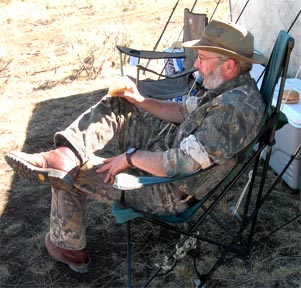
This was an unusual year in that we took no days off, had no town days, failed to go in to shower (usually a Craig imperative). We hunted hard, constantly. Yes, Ted drove to Rawlins to take in his cape and meat; but alone, and was back in a jiffy. I drove to town one afternoon, for gas, and came right back.
It wasn't until the party was down to just me and David that we took a rest. We gave up the first day of elk season. David was exhausted from his week, I had meat ten days old that wanted to be frozen, and elk success would depend largely on public land hunters driving the elk out of the mountains and onto our private land, a staging area before dropping down to winter range. So we headed to Rawlins.
On the outskirts of town we saw a Fish & Game check-in set-up, a mandatory stop. I was a bit flustered during our time there - I'd shot five animals, couldn't really recall which I'd already butchered and whose meat was in my cooler, and which I'd left in camp. Worse, I'd cut up one quarter of one of them, so I had part of it with me and part in the tent, with the carcass coupon where the majority of the animal was - 50 miles away. I had carcass coupons in one pocket, license stubs in my buttpack: bits and pieces of my stuff here and there, and trying to figure out what belonged with what.
We got all of that more or less straightened out, and they didn't bother about the extra quarter. But, they didn't like that I didn't still have evidence of sex attached to my doe antelope meat. I'd long been going under the theory that such was no longer needed once the meat was cut and packaged - wrong! The two F&Gers were not wardens, so they couldn't take or decline an action on the spot. So they jotted a few words on my license, and wrote up a little incident card that they'd have to turn in to a field man, telling me that I may or may not receive a visit at camp for a compliance check. I never did, and good thing - I'd already removed the ev-of-sex on the other animals, though I did have a baggie of balls still in one of the quarter bags.
Tom the taxidermist had bought the meat processing business next door to his shop, after it had been shuttered by the health dept., I suppose because a lot of business came his way from folks initially driving in simply to get meat cut.
Poor Tom was a busy, busy, boy. I recognized some of the same employees at the butcher's, but Tom was putting 90% of his time in there, trying to learn the ropes and keep it humming, leaving the taxi shop either to Grant, his #1 assistant, or locked up. As a taxidermist, although quite busy during the season, what comes in can be quickly fleshed and then frozen, or even immediately frozen, and then taken care of at 'leisure'. But carcasses take up a lot of freezer space, need to be packaged before spoilage, and hunters often have short deadlines before they need to pick up their frozen & packaged meat and head home, whichever State that might mean.
On the afternoon that David and I arrived with my cooler full of Ziplocs, he was at wits' end: out of space for carcasses, out of space for boxed meat in the freezer, and low on available employees - he padlocked the gate for the day (while we were there! He had to come out to unlock the gate so we could get out. - David); I was the second-to-last customer (I've no doubt he would have found a spot for me nonetheless).
Craig later reported that Tom had been in the same frazzled state when Craig took his animals in. I'm happy to report that when I picked up my meat on Oct. 24, things were much more relaxed. Tom was active (as he could never not be), but he was under control, master of his world.
I brought to Tom a piece of wood from the ranch, a hollow hunk, very similar to a cornucopia, perhaps 18x9", to use in some hunter's diorama when Tom thought fit. All I requested was a photo of the finished product.
I got more road info for my map of Five Buttes, although I'm far from finished. Earlier this year I'd hoped to be able to spend a week out there during July, when rain wouldn't hamper me and my travels wouldn't hamper hunters. In the event, the rain hampered me and I was polite enough to keep away from where the boys might hunt, so I mainly nibbled around the edges and never got to the roads where we hunt (the most useful info to have).
But the duty did take me to some spots I'd not explored before: to the top of one of the Ketchum Buttes, where some prospecting had been done, leaving flat tops instead of pointed cones; to Cow Creek, on foot and hunting, where one theory of mine as to a deer hideaway was exploded; and, after all these years, to the roads on Lost Ridge, so named because the lack of a driveable road (more truly, our lack of knowledge of a driveable road) made the ridge 'lost' to us. If we'd been sure of access, David and Ted and I could have been spared some hard pack-outs during previous trips. I also discovered that there is still at least one way to put a car on the two-track we see along the bottom of lower Bird Gulch, another key back saver.
Driving along these old roads, some long abandoned, finally got me to the monument on Dillon Ridge. A four-foot tall column of nearby rocks similar to paving stones, it's visible from any number of vantages. I added one more stone.
Those same old tracks, now well grown in sage, completely cleaned the bottom of the Bronco of the mud accumulated from driving while under the influence of rain. Unfortunately, it later rained and snowed some more - I recovered eleven or twelve gallons of mud when I hosed off at Golf Links.
And I learned that one way to see unused roads is to look for them when there are couple of inches of melting snow on the ground. The contrast of dark sage brings out theretofore unnoticed sets of parallel white lines. So now I have hints of even more trails to map!
It was after perhaps the third year that I kept marked on my map (but I don't print that layer) my GPS data points, so an incomplete total is currently 880. Let's say I've taken about 1000 GPS readings, trying to make the map accurate.
It's been a fun project, one I hope I can complete.
Silly me: while I was on top of Ketchum Buttes, hoping to see some sort of hole and other signs of traditional mining activity, I didn't think to fill my buckets. Loose rock for the taking, thanks to the bulldozing of the unknown prospector, and I left it on the ground!
Craig had 'paved' the way for me before I arrived, as I'd requested, asking Charlie for a few five-gallon buckets I could use to collect rock to use as rut fill. Charlie had OK'd the idea, but couldn't guarantee empty buckets; most of his at his home HQ were in use. And he added some comment that I could fill the large pothole in the driveway to the corral. Not being present for the conversation, I was unsure of the meaning of the comment, nor its verbatim words. I figure it was an unserious offhand crack, but couldn't be sure. But even if it was - especially if it was - my fixing that spot should be amusing to Charlie. So, 80% of my efforts were dumped on his entrance road.
My car was nearly empty, the camp gear left at camp, so it was no imposition to carry about the two buckets I was able to scavenge from the corral area (one an ex-tar container, still gooey!). During the weeks I'd stop, when convenient, by any place where I noticed sufficient surface rocks next to the road, and scrabble the buckets full. Then, since I'd usually pass Charlie's driveway on the way back to camp, I'd turn in and cure his depression.
It sounds easier in theory. As it turned out, because of weather, time or timing, hunt location, or rock concentrations, I hauled only 100 gallons (ten instances). 80 of them, wonderful flat stones, went to the pothole; the other twenty, more like riverbed rock, I lined into the deep ruts in front of our camp. I think I solved the mud hole for Charlie, making it now just a water hole that needs to be filled up to grade. As to our camp ruts, they need a lot more work; but there's now a bit of base that should lessen our skidding in the mud.
This project, on a larger scale, was the second purpose of my hoped trip out to WY during the summer.
Our first year at Five Buttes, under a trespass agreement with Gene Carrico rather than our current arrangement directly with Charlie, we hired for a day one of Gene's guides, Bill Nation. Our day began by sitting on an elevated point in the vehicles and glassing in the dawn. We saw a buck in the sage way out yonder, and drove nearer.
When we arrived, there was no deer to be seen. Bill suspected that the buck was lying in the sage somewhere nearby. He sent Ted and me up on a butte (I'm guessing, the one by our camp) to watch the territory while he and Craig criss-crossed the area. Back and forth they went, the forths surprisingly close to the backs - under the strong possibility that the deer might sit tight and allow a couple of sense-deprived humans to stroll right on by.
After a fair while, they jumped a buck at a distance best measured in feet. It wasn't a shooter for us, we let it go. But the experience was an education: the deer had bedded within 200 yards of the county road; it'd bedded right out in the flats of sage, with no other cover; it'd let us drive by and walk around.
Ever since, we've discussed making some drives abreast on the flats, but have never gotten around to it. We see deer in the open late or early, inferring that they'd spent the day in the out there. I've watched deer leave the canyon rim in the late morning, with only two possibilities: bed on the plateau somewhere or travel two miles across it to the cover along the next creek. But we always seem to hunt alone (not complaining, mind you), and that in the draws or canyons, along the rims, around the aspen pockets or serviceberry concentrations - never on the flats. It's true that its common to cross an expanse of sage in the course of our hunts; I think its somewhat rare that we pop up unseen deer.
This trip I went through with a plan I've had for a couple of years - to get close to another owner's fenced pasture, that juts into a large flat area of our property, across and in which I've seen deer in numbers, albeit mainly does. I used my map to select a parking spot convenient but well out of play, and its grid of coordinates to enter UTM numbers into my GPS. I parked in the dark of morning and easily followed my GPS directly to the corner fence post into which I hoped to blend. I stood out the cold wind for nearly three hours but saw none of what I hoped. But I did see that a fair number of deer were disappearing into the sage a bit over a mile away, closer to Bird Gulch but still a half-mile from the rim - out in the middle of nowhere.
One late evening I sat by the opposite fence of that pasture (Sheehan's Field on your map), and saw a nice buck in its center. The next morning I watched, from too great a distance, a pair of bucks leave the pasture and head out into the plateau. I returned that afternoon so that I could set up before deer began to filter in. That plan worked perfectly, although the two bucks that appeared in the sage and strolled to the pasture along my line of fire flunked the 'monster' test.
I had occasion to drive through that large area, call it three square miles of flat or rolling topography, most of it thick with fairly high sage, right around "can't see". I saw plenty of deer, many bucks, as I went.
So (we're getting to the point of all of this, now) one early mid-day when I found myself out on the rim of Bird, after walking the shelf of the canyon, I decided to try The Great Sage Walk, to finally do it and see what might happen. I began from where I'd parked, not far from the rim on the west side of the Rim Plateau, and angled a bit away from the rim as I headed east, keeping a peak in far distance at the end of my nose. That course would take me through where I'd seen the greatest concentrations of deer.
The first part of the walk was lonely, as expected, in sparse and short sage. Then up ahead I saw a feeding doe. She watched me, and browsed, at 400 yards. As I neared, another doe and a fawn arose from their beds. Somewhat over 100 yards away they all bounced away toward Bird.
Poking up over the top of a slight roll I also saw the rack of a smallish buck. Because of topography and my skill, he was never aware, and I lost sight of him as my elevation changed. I slowed and grew extra alert as I neared the area where he'd been. Then my binocs picked up the tines of two bedded bucks, the tines seeming exactly the height of the sage tips. I crept forward, and at 40 feet they leapt to their feet and bounded away. I was at the ready, rifle at port arms, expecting anything and hoping there might be a third, larger, deer. Even though I was so ready, I had absolutely no chance for a shot of any kind. They were up and gone over the roll in less than an instant.
I could see the occasional bound over my horizon, and they stopped once or twice for a look-see. When I finally crested the rise, they were 200 yards away and going, and taking a half-dozen other deer with them. Before they went over a slight lip and out of sight, they'd roused a few more deer and sent them all away.
It should come as no surprise that the next few hundred yards of my walk gave me no new sightings of animals. I reached the road that marked the end of my walk, a road that soon reaches Sheehan's Field. I went down it for a hundred yards and spooked up another group of deer. They milled and then trotted downhill, again gaining a few recruits. As I again changed directions, now heading west parallel to the first leg of the walk, that group split in two - some continuing downhill, and picking up a few new members, the others running ahead of me and then crossing, aiming for the rim of Bird, also rousting out some more bedded deer. Among all of those, the bucks were small. The only entertainment I had during the long trek (it was about a mile each way) was a trio of antelope that didn't quite know what to do about me.
So I'd finally done it, a one-man drive through the sage. And I won't do it again, in a similar way, without need. Yes, there are deer bedded on the flats, and they can be gotten up. But they may well be up & gone without allowing judging or shooting. Or they may leave while still a few hundred yards away. On level ground in high sage, only offhand shots are possible (or shots over standing bi-pods, I suppose); I see no reason why I might want to attempt a 200-yard shot, offhand, at a bouncing buck. And the odds that the first deer up, up, and away might snowball all of the nearby residents seem to approach 99%; I'd hate to see a Booner pop out far ahead because some silly fawn was frightened by my passage.
David may well have had my tale, and the conclusions I drew from it, in mind when he debated with himself whether or not to try for his buck on the high-sage expanse of Lost Ridge.
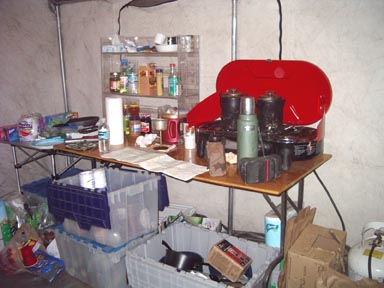
We ate the usual suspects for dinner: hamburgers; steak; fajitas (though Ted and I stole some of the planned fajita meat and ate steak sandwiches one noon); boneless/skinless chicken breasts (vs the usual bone-in/skin-on) (and I BBQ'ed them to perfection, against Craig's expectation of dryness - so there!); pork chops; bratwurst chili dogs; spaghetti; BLTs; canned ravioli. We'd eat the fresh, perishable items first, and have the others available in case we didn't get to town or if the weather turned bad and made outside cooking inconvenient. Craig made the occasional salad, but not as regularly as usual; I tossed out quite a bit before I left. Two or three times Craig pan-fried potato chunks to a tasty brown, and a couple of quick-fix packets of Mexican-style rice came in handy as sides. We aim for simplicity and speed.
Our usual routine has us straggling in from our individual hunting spots after dark, and that can mean an hour after dark, depending on the sum of the hike and the drive. The first one back should start up the sage fire in the shoveled pit. Then comes the usually brief choosing of the menu. And we want it all over quickly because it's so soon nine or ten o'clock, and five AM threatens.
I've become the de facto grilling chef, I think because I'm the only one now willing to leave the warmth and windlessness of Craig's canvas tent (I lost my companion, Ted, a couple of years ago; he's been seduced by comfort, ruined). Craig is the salad chef because only he wants to go to that much trouble and because he's mighty picky about rinsing all of the greens. He's also the main side dish cook, by some default.
Our habits of food and cooking have worked well, have suited, in my opinion. But it's true, as David mentioned, that we have little opportunity to camaraderate. We awaken to Craig's rude banging, shaking, and coarse words at five. A short and surly, and usually cold, gathering in the tent ensues. Some might scarf a muffin or a bowl of cereal. We inform each other of our chosen destinations and straggle away in the dark. Full days afield are almost as common as is coming in at mid-day, and the coming in is rarely coordinated. It's often one of the lunchers who replenishes our pile of firewood. So our only 'together' time is after dark and short. We eat in the tent (can't get some of those boys out), so there're no relaxing hours around the campfire to trade stories and lies. Because of our busyness hunting, and a lack of preparation, this year David did not stay in camp a day to nurture up his dutch oven chuck roast specialty.