Montana Hunt 2011
Wednesday, Oct 26

Page Eight
First posted November 28, 2011 Last edited November 28, 2011
David's Fifth Day: Quest for the 6x6
Wednesday started out colder than any previous day.
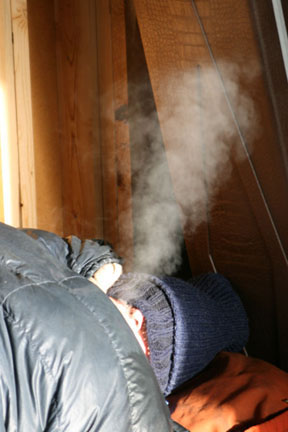
Here I am on another day, sleeping in, but you can guess how cold it is by the condensation
We would guess at the temperature by how far out from our faces that our breath condensed, and then we would check the thermometer. Bill's said 6 degrees. We were getting used to having all the water frozen each night, but the mercury was having as hard a time as I was at getting up each morning. In order to have drinking water, I would put a bottle in the foot of my sleeping bag. Craig would pour some water into a pan the night before, it would freeze overnight, then he would melt it on the stove the next morning for coffee. Sometimes the water bottles thawed out during the day, most often they would not. I put a few in the window, where the afternoon sunlight might make them melt. Emphasis on the might.
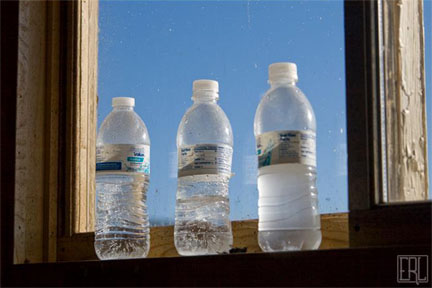
Frozen bottles of water hoping to catch enough rays to melt (Larson photo).
I had ice crystals on my mustache when I woke up, and the opening of my sleeping bag had so much frost that I had to brush it away so that the crystals would not land on me as I got out of bed. That was already enough of a hurried affair. A rush to avoid getting cold. But speed did not alter the temperature of the clothes I was jumping into. From the cold into the cold, but I still thought it was not as bad as prior years. Either I am getting used to it or my memory is failing...
I was not thinking about the cold as much as I was thinking about the 6x6 bull Craig had seen, and I was about to hunt. All the guys were great and had decided to leave this area to me. Craig told me that he had done his part in finding the bull, now it was all up to me. He was heading elsewhere to find a buck. All the others gave the creek a wide berth so as not to disturb it.
I did not eat breakfast or drink coffee in the mornings as a rule, so as to try to delay peristalsis to later in the day when there was a chance that the temperature might be above freezing and my derriere would not suffer the fate of the water bottles. I packed my gear and again borrowed Bill's Bronco.
The cold night plus the moisture of the valley meant that each morning would find a thick coat of frost on the windshield.
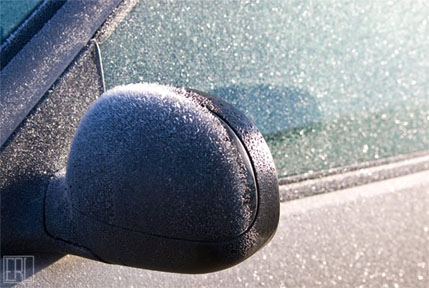
The frost was thick in the morning (Larson photo).
The scraper was in the glovebox, but it seemed as frozen as the rest of the world. I struggled with it, could not open it no matter how hard I pulled or how much I damaged my fingers. I gave up and looked for a substitute. Failing in my search, I tried the glovebox again. No dice, frozen tight. I looked around again and didn't see anything promising. I gave up looking for something good and settled for something not terrible. The only thing I found lying around outside was the fire tongs. I tried scraping with them, but their rounded profile and curving contours made a joke of window scraping. Any moron should have known that would not work, but I was getting desperate. I put them back and again tried the glove box. I pulled and I pulled, but only succeeded in breaking the latch, with the door still frozen shut... I would have to tell Bill I wrecked his precious Bronco. I only hoped that this was a novel and perhaps cheap part to break...
I found a bit of wood, I think, and scraped with more vigor than results. Just enough to be able to negotiate the access road and its boulders; luckily there was no traffic to worry about. I just wanted to get back to Craig's Valley of the 6x6, and all I had accomplished so far this morning was breaking Bill's car.
I struggled up the wacky access road and succeeded in not hitting any trees or boulders. I was confident now in finding the turnoff from Highland Highway and despite the minimal aperture of sight through the windshield, did not need the GPS anymore. I parked and got my gear on.
The road was frozen solid. My bootprints from the day before were now petrified and made for awkward footing. Talk about being hoist with your own petard! Also, instead of "pussyfooting", I was "crunchyfooting": my steps crunched each time I put my weight down. It was like having your own brass band heralding your approach to all the elk in the county. No such thing as quiet when the ground is frozen.
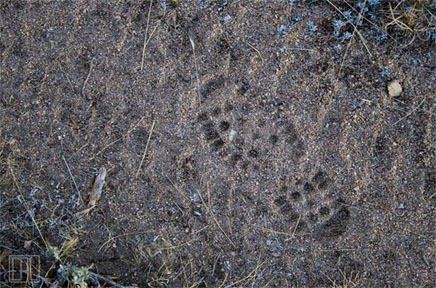
A frozen footprint (Larson photo).
Not only was the windshield frosted. Every time I put my binocs up to my glasses, the glasses fogged so badly I could not see. It was maddening. No matter which way I directed my exhalations, my glasses fogged. I decided it was not my breath but the moisture rising from my face that was the culprit, directed to my glasses by my hands. I was sure that my glasses would fog just as the 6x6 jumped out. It took a lot of time and effort to pull out a Kleenex and wipe the lenses. I struggled with this problem until the sun was fully up.
I headed down the road in the dark with high anticipation, and wanted to be sure not to blow this chance, esp after the elk-drought of the past three days. I tried to scan everything with my binocs, even though I thought my best chance of seeing him would be in the creek bed. I tried to keep close to cover as I worked my way down to the rock formation that marked the entrance to the creek, crunching frozen leaves and twigs as I went. I moved over to the regenerating clearcut Craig was supposed to have covered in our trip here yesterday as the dawn was breaking. I was wondering, Why was the bull had been out feeding at 4 pm?, as I tried to make my way quietly through the young trees. Damn! I thought, these guys are awfully close together. I had scraping live branches everywhere above ground and crunching dead branches everywhere underfoot. Why was he out so early on the previous afternoon? Would that have any bearing on what he might be doing now, after a night of feeding? I did not like what was going on in the regen trees, with all the swishing on clothes and crunching underfoot, so I tried moving out of them as soon as I could. I kept glassing the forest edge, in case the bull might be returning from his night's feeding. Nothing but increasing daylight.
The alternative to the regen forest was struggling through the slash left from the timber harvest, so I tried that. This was even worse in terms of noise and flailing, but I kept glassing as I tried to minimize the noise. The mature forest to the right of the rock formation was open enough to have some grass, and there was an excellent, well-travelled path coming out of the creek bed and going into the forest. I tried to peer as deep into the forest as I could. Nothing. Eventually I made my way to the rock formation, a bit past first shooting light.
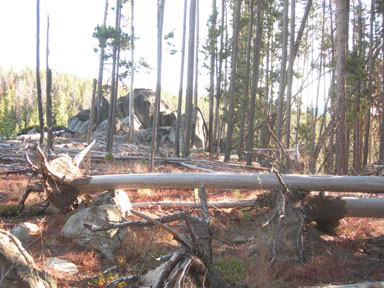
This is the rock grouping at the edge of the creek.
The ledge is not seen well in this photo, but is barely seen on the far left.
As I approached the place where Craig and I had separated at the rock formation, I tried to decide if I could climb them and get a bird's eye view of the creek bottom. Skylining myself would not be great, but if I did it very slowly I might get a better view of the creek bed than on foot, and it would not make any noise. I found that the rock was protected by a moat of junipers, but by moving left ten feet, I could push my way to a short path past the outer rocks and get to a rock ledge high enough that if I stood on it in an awkward sort of crouch, I could peer over.
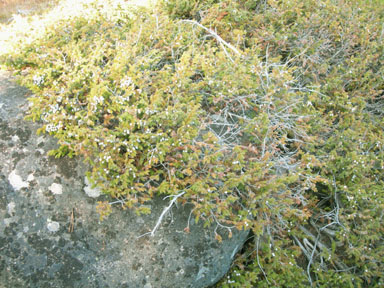
This is the juniper that was surrounding the rock and making it hard to get to the ledge.
I made my way through the juniper, almost quietly, and got to the ledge. With some undignified moves and by setting my gun against the rock for a moment, I managed to get up onto the ledge. I retrieved my gun, took off my hat to lower my profile, then very slowly and expectantly lifted my head. I could see over the top without standing up fully, but the stooped posture was a bit uncomfortable.
I had a great view of the creek bed, both up and down the creek as well as from the near side to the far. There was a small creek flowing in a meander down the bed, sometimes on the far side, sometimes in the middle. There were willows and forbs growing along its margin. Interspersed along the bed were trees. My memory is like my glasses, foggy, when it comes to what kind they were, but they probably were pines and aspens. They could have been alders or sycamores. The forest on either side extended down to where the gravel started, the high-water mark of the creek when it was swollen by rains. It was an old forest, with large trees as well as copious downfalls, and open areas of moss and grass going up the hillsides. I scanned the creek, keeping as low a profile as I could. Nothing. I tried to be very thorough, checking behind every tree for an ear or a head or a hoof. Nothing. I changed my focus to the hillsides right along the creek and all the way to openings up the mountainside. Nothing. I slowly lowered my head.
This was very disappointing, but I was having a lot of fun. My pulse raced and I was being much more cautious about how I moved. The thought of the proximity of a 6x6 bull can do that to you. I was not done hunting, so there was still a chance he was there somewhere.
I rested a bit from the discomfort of the crouch needed to keep a low profile, then very slowly I periscoped up the minimal amount, just my binocs and the top of my head showing. This was marvelous territory, with great dark cover just steps away from the grasses growing on the bottomland. But no elk. I peered as far upstream and downstream as I could, and up the sides of the canyon. Nothing. Periscope down.
I rested a bit. Turning around to think, I noticed that the junipers here were full of berries. I thought of my next move. I decided to take a last look, then move into the creek.
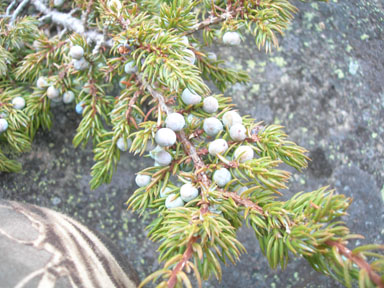
The juniper was full of berries but I had not noticed them
when I pushed my way through them to the ledge.
Periscope up, nada, periscope down.
Cautiously I climbed down from the ledge and waded through the junipers, making my way around the rock pile to a prominent path leading into the creek. It was covered with small twigs and branch fragments, which made it hard to be quiet and yet not fall down the steep path. I succeeded partly at both. Looking back at the rock outcropping, it was quite different from the perspective of the creek.
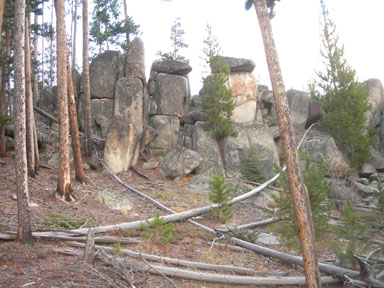
The rock outcropping from the creek side was much taller
and had the appearance of stone blocks stacked one upon the other.
I slowly moved into the creek and found an elk path (sounds better than cow path) along the edge. This made it easier to be quiet, and I moved down the creek, from tree to tree and cover to cover, using my binocs to study for any part of an elk grazing ahead. The sun was up now and I was not fogging up all the time. It was quiet and empty.
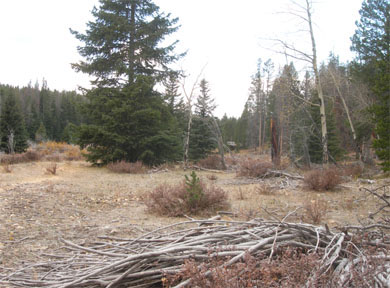
The view down the creekbed.
The cabins where I waited for Craig can be seen just right of center.
The creek bed was mostly gravel with willows along the creek itself, scattered aspens and other trees, plus grass. There was plenty of cover in some areas, especially the willow thickets, and I also was scanning the forest on either side. Most of the areas were free of branches and twigs underfoot and I could move quietly, but close to any tree the ground was thickly covered with noise-making litter. The creek was flowing but its margins were covered with ice.
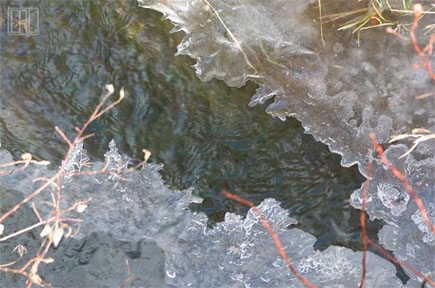
Ice formed along all the creeks (Larson photo of Moose Creek near our cabin)
It was only about 200 yards from the rock pile to where I had been waiting for Craig the previous afternoon. I moved so slowly that it took me over an hour to cover that distance. It was more like mobile still-hunting rather than trying to cover distance. I was so sure that an elk was just behind the next tree or willow clump, and my guess was that it was better to stay in prime country hoping something will move in than to rapidly cover the prime stuff and move on to wretched territory. Nothing.
I examined the cabin when I reached it. There was only one log cabin, although the map showed that there were two. It had been fixed up some time long after it was originally built, but was still in disrepair. A tin roof had been added. The back was built into the embankment, with no wall. I was not sure if they were trying to use the cabin as the entrance into the mine or what.
I must admit I was surprised to find that my hunting spot of the night before was only about 200 yards from where Craig had started his stalk. Even if Craig had only gone a short ways down the creek, the bull, all 6x6 of him, must have been just out of my sight up the creek. So close and yet impossibly far. How often do we pass a bull at close quarters and never see it, I wondered.
I knew that further downstream the creek opened up a lot and shortly below would be exposed to roadhunters on the Highland Highway, so I did not continue down the creek but instead moved into the forest and hunted the deep woods at the bottom of the road. This area, too, had seen some logging very recently, and so had open areas that had not yet regrown interspersed with old trees. There was grass and elk sign all over, so I moved slowly, intently scanning the forest.
I worked my way through some old timber, with lots of good cover, openings with grass, the works. Excellent elk territory and lots of elk sign. I hunted back up to the grove of aspens I mentioned earlier, and then passed into open sage. My hunt for this morning was over.
I saw nothing, but I think I learned to hunt more intensely, as if the biggest elk you can imagine is just around the next curve of the path.
I headed back to camp, ready to come back to this area for the evening hunt. The great cover, heavy forest, grasses in clearings as well as the creek, plus strong elk sign suggested that the 6x6 that Craig saw munching on creek bottom grasses might not leave so quickly, and probably was not the only elk around. This territory merited another look.
Back to Wyoming Homepage Back to 2011 Homepage
Back to 2011 Page One: Introduction Back to 2011 Page Two: Opening Day
Back to 2011 Page Three: Craig's Elk Back to 2100 Page Four: Finding Craig's Elk
Back to 2011 Page Six: David's Meadows, Day 3 Back to 2011 Page Seven: 6x6 Canyon